Delhi-numret
Standing Under Delhi's Qutub Minar Before the Crowds
The carving is at ground level and the online ticket is ₹35. Behind the gate, a thousand years of ruins sit unfenced and free in the scrub.
Av Bram VerhoevenA Dutchman reading Delhi one neighbourhood at a time

The staircase inside the Qutub Minar has been sealed since the 1981 stairwell disaster, and nobody climbs it. You read the tower from the ground, 72.5 m of fluted red sandstone and marble in five storeys. Behind the ticket line sits a thousand years of ruins that charge no entry fee.
What stands inside the Qutb complex
Qutub Minar and the Qutb Complex (Mehrauli) is an open, ASI-ticketed archaeological site with wide lawns. The tower tapers as it rises, banded horizontally with carved Kufic inscription. Its projecting balconies are carried on honeycomb muqarnas brackets, and the carving at eye level is worth standing close to.
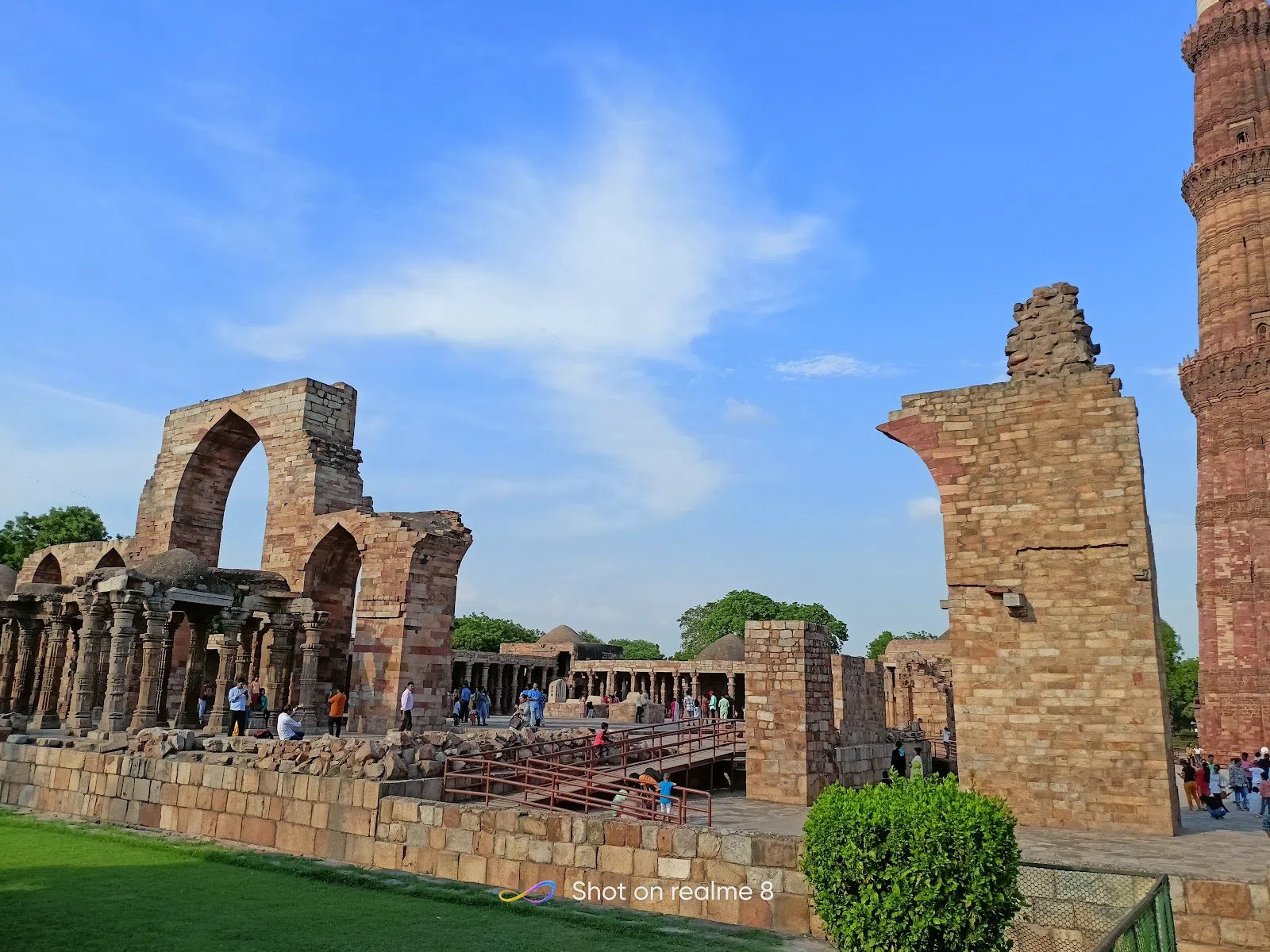
Behind the tower runs the Quwwat-ul-Islam colonnade, its pillars reused carved temple stonework, with the pointed-arch screen in front of it. The slim 4th-century Iron Pillar is in the same courtyard. Licensed guides tout for work at the gate.
Planera din resa till Delhi
Aktuella priser från våra bokningspartner.
Gratis avbokning på många rum. Vi kan få provision när du bokar.
Tickets and the two queues
The online and counter queues run separately. Indian and BIMSTEC nationals pay ₹35 online and ₹50 in cash at the counter. Other foreign nationals pay ₹550 online and ₹600 cash. Children under 15 enter free. Buy the ticket online before you travel out to Mehrauli and you walk past the counter line altogether.
Guided day tours of Delhi that take in the complex run seven days a week, and they fill up, so reserve a few days ahead if you want one.
Best time to go
The complex opens at sunrise and closes at 8 p.m. every day, with no weekly closing day. Take the first hour for the base of the tower, while the lawns are still empty. In the middle of the day, walk into the park behind the fence, where the shade is.
Mehrauli Archaeological Park, free and unfenced
Mehrauli Archaeological Park (immediately behind the ticketed complex) is unfenced, unticketed and free to enter, 200 acres of scrubby kikar-and-thorn parkland crossed by bare dirt paths. Domed rubble-masonry tombs stand loose among the trees, and collapsed Lal Kot rampart walls run through the scrub. Rose-ringed parakeets go over, and the top of the Minar shows above the treeline.

It is the least visited part of Mehrauli, with no crowd and no fee. Walking groups use it constantly and there is no door policy at all. Wear closed shoes, and don't wander it alone after dusk.
Rajon ki Baoli (Mehrauli Archaeological Park) is the handsomest structure in the park. Four descending tiers of arcaded sandstone colonnades step 13.4 m down to a rectangular green-water tank, the plastered arches carrying faded medallion ornament. ASI finished a full conservation of this 1506 Lodi stepwell with World Monuments Fund India and reopened it to the public in May 2025, desilted, repaired and watered again. At the bottom the shade is deep even at midday. The lower steps are narrow and slippery, and a large party bunches up on them, so send people down a few at a time.


Jamali Kamali Mosque and Tomb (Mehrauli Archaeological Park) was built around 1528-29 for the Sufi poet Shaikh Jamali and his companion. The mosque is red sandstone with a tall recessed central arch, and its mihrab wall mixes grey Delhi quartz, red sandstone and white marble. The small square tomb chamber beside it is why you come. Its interior is painted in intense blue and red plaster with Quranic lettering. The gate is usually padlocked, so ask the attendant to open it. Without that you have seen half of the monument.
Balban's Tomb (Mehrauli Archaeological Park) is austere and half-collapsed, a roofless square chamber of coursed rubble masonry open to the sky with plain arched openings on each side. The surviving arch is the first true arch built in India, pointed rather than corbelled. The Alai Darwaza and everything after it depended on it. The site is unstaffed, with no shade and nowhere to sit.

Metcalfe's folly and the framed view
Tomb of Muhammad Quli Khan and Metcalfe's Folly (Dilkusha) (Mehrauli Archaeological Park) is an octagonal domed Mughal tomb built for an Akbar-era general. Thomas Metcalfe remodelled it into his 1830s weekend retreat, Dilkusha, adding sash-style openings and painted plaster inside and a stone-paved terrace outside, then scattered follies around it. A separate domed baradari sits on the rocky ridge opposite, with the Qutub Minar rising behind it. That is the classic framed view of the tower, and almost nobody makes the walk. It is reachable only on foot through the park, with no vehicle access.

Ahinsa Sthal (five minutes from the Qutub gate) is the calmest high ground in Mehrauli, and almost no visitor takes the detour. A 13½-foot seated Mahavira, carved from a single block of dark granite, sits on a lotus pedestal on white marble terraces laid across a bare rocky Aravalli outcrop. The Qutub Minar is visible across the trees. Shoes come off on the terraces, and leather items are discouraged inside the shrine.

Mehrauli village and its living shrines

Adham Khan's Tomb (Bhul Bhulaiya) (above the Mehrauli bus-stand junction) is octagonal rather than square because its occupant, Akbar's foster-brother, was executed for murder and buried in disgrace. The tomb sits on a raised plinth under a low flattened dome, with a deep arcaded verandah. Narrow unlit passages thread through the thickness of its walls, which is why locals call it the maze. Bring a phone torch. It is open in daylight, free, with no dress requirement.
Dargah of Hazrat Qutbuddin Bakhtiar Kaki (Mehrauli village) is Delhi's oldest Sufi shrine, and the village grew up around it. The white marble shrine chamber is draped in green and gold cloth under a canopy, behind pierced jaali screens. The approach lane is lined with stalls selling marigold strings and rose petals by the basket, and rows of shoes are left at the threshold. Entry is free, all faiths are received and it opens daily, with donations and flower offerings extra. Modest dress is expected: long trousers for men, a head covering for women, shoes off. Some inner sections are restricted by gender. This is a working place of worship, so ask before pointing a lens at anyone praying.

Yogmaya Temple (Mehrauli village lanes) is one of very few Delhi temples claimed to predate the Sultanate. The shrine is compact and marble-floored, its sunken sanctum under a silver canopy, with a brass bell hung at the entrance arch and courtyard walls closing it off from the lanes. Darshan runs 5 a.m. to noon and 4 p.m. to 9 p.m., and shoes come off. Its festival and the dargah's share the same procession, which tells you more about Mehrauli than the monuments do.

Jahaz Mahal and Hauz-i-Shamsi (Mehrauli) pairs a low rectangular Lodi-era pavilion with a five-acre tank. The pavilion has corner chhatris and surviving patches of blue tilework, and it sits right on the water's edge. The 1230 reservoir was a dead, choked tank until an ASI and SEEDS restoration cleaned and aerated it. It now holds clean water behind fenced banks, with floating reed bio-islands, solar aerators and waterbirds working the shallows. Migratory birds come in, and the pavilion is the start point of Mehrauli's autumn flower-sellers' procession.

Sanjay Van for a hot afternoon
Sanjay Van (the green buffer between Mehrauli and Vasant Kunj) is dry deciduous ridge forest, kikar and native planting cut by narrow earth trails. Small domed tomb ruins appear unannounced among the trees, and the Neela Hauz lake at one edge holds waterbirds. It opens daily from 6 a.m. to 8 p.m. and has multiple gates. Phone signal is poor in there. Go in the morning, stay on the main trails, and don't go in alone at either end of the day.

Walking it with a resident guide
The park is unsignposted, and the village lanes give you nothing to read. Project Mehrauli (Mehrauli) is a social enterprise run by local residents, running small-group walks by arrangement and documenting the sites publicly. A guide takes you on foot between the dargah's flower stalls, a stepwell's arcaded tiers and the tombs standing in open scrub. Email ahead for timings and group bookings. Walk fees are on enquiry, and the money stays in the neighbourhood.

Eating after the complex, and the tower lit up
Olive Qutub (Olive Bar & Kitchen) (One Style Mile) has been the long lunch after the complex for two decades. The restaurant occupies a restored Mughal-era haveli, whitewashed, with white lime-plaster arches and alcoves inside. The walled courtyard carries bougainvillea and potted olive trees, with candles and lanterns once it is dark, and the courtyard rather than the indoor rooms is what you book for. It opens 12:30 p.m. to 12:30 a.m. daily and costs around ₹6,000 for two. Book a courtyard table.


ROOH (Ambawatta One) gives you the floodlit Minar after the complex has shut for the night. The first-floor open terrace has low lounge seating and planting along the parapet, and the lit tower stands directly beyond the rail. It keeps dinner hours, so pair it with a late-afternoon visit to the complex. Expect ₹4,000 to ₹6,000 for two. Groups are taken by reservation only, terrace tables are the scarce ones, and you must ask for the terrace explicitly when you book.
Champa Gali (off Westend Marg, Saidulajab) is cheap, vegetarian-friendly and a short ride from the gate. A narrow brick lane of converted light-industrial workshops holds a dozen small independents, with fairy lights strung overhead and neem trees in the yards. Seating is mismatched wooden benches and low tables, chai arrives in clay kulhads, and ₹500 to ₹1,200 covers two. Most seating is first-come, and the courtyard tables fill in the evening. A group can split across the kitchens here instead of settling on one menu.

Is it worth it
It suits a visitor who will walk unpaved paths for most of a day and who wants to look at carving instead of a view. The ticketed complex is a short stop at ground level, and the free park behind it can take the rest of the daylight.
Practical
No monument here keeps a weekly closing day, and the only fixed break is Yogmaya Temple's midday one, so plan the village lanes around it. Buy the complex ticket online, email Project Mehrauli ahead for a walk, reserve your restaurant table, and carry closed shoes and a torch.
See the Delhi guide and the Delhi hotel search.
Innan du åker
Can you climb the Qutub Minar?
No. The staircase inside the minaret has been sealed since the 1981 stairwell disaster. The visit is all at ground level, and the carved Kufic bands and the muqarnas brackets under the balconies are close enough to read.
How much is a Qutub Minar ticket, and is it cheaper online?
Indian and BIMSTEC nationals pay ₹35 online or ₹50 in cash at the counter; everyone else pays ₹550 online or ₹600 cash. Children under 15 go in free. The two queues are separate, so booking online also saves you the counter line.
What time does the Qutb complex open and does it close on any day?
It opens at sunrise and closes at 8 p.m., seven days a week, with no weekly closing day. The base of the tower is quietest in that first hour.
Is Mehrauli Archaeological Park free, and is it safe to walk?
It is free and unticketed, there is no fence and no door policy, and walking groups use it constantly. Wear closed shoes for the bare dirt paths, and don't walk it alone after dusk.
What should I wear at the dargah and the temple?
At the Dargah of Hazrat Qutbuddin Bakhtiar Kaki, men wear long trousers, women cover their heads and shoes come off at the door; some inner sections are restricted by gender. Yogmaya Temple is shoes-off too, and it closes in the middle of the day.